


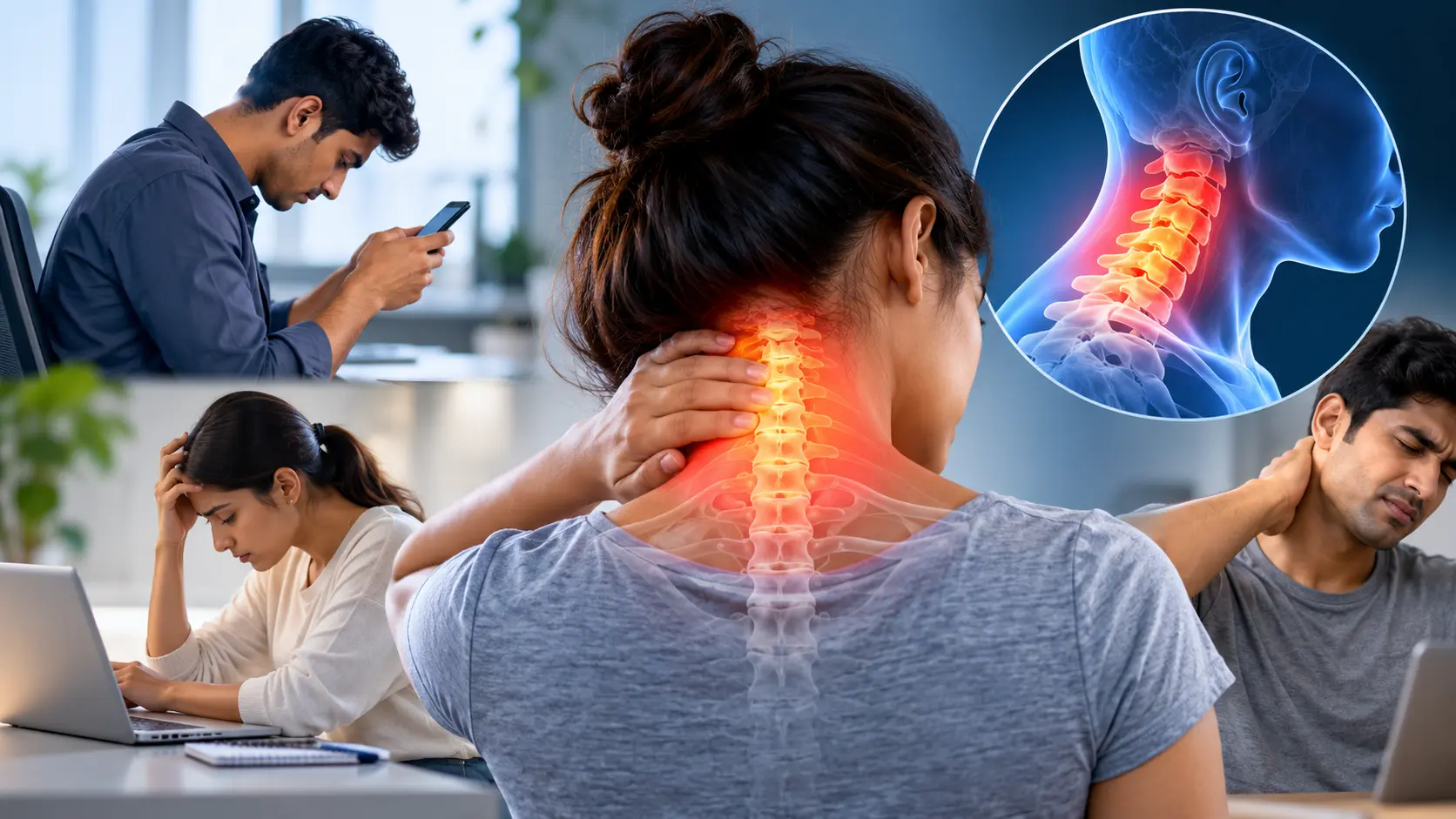
Cervical spondylosis in young adults is no longer a rare finding. Clinics across Coimbatore now see software engineers, students and remote workers in their 20s and 30s with neck degeneration once expected only in retirees. If you wake up with a stiff neck, feel an ache by mid-afternoon, or notice tingling in your fingers, your spine may be warning you early.
This guide explains why the condition is rising, how to recognise it, and which steps protect your neck. It draws on the experience of the doctors at Edamanasserry Spine Hospital, a Coimbatore centre with over 50 years of Ayurvedic spine care.
What Is Cervical Spondylosis in Young Adults?
Cervical spondylosis is wear and tear of the neck spine. Discs lose water and height, facet joints stiffen, and small bony spurs (osteophytes) can form. These changes may press on nearby nerves and cause pain, stiffness or numbness.
In older people, this is a natural process. In your 20s or 30s, it is premature, and lifestyle is usually the trigger rather than age.
Your neck supports a head weighing roughly 4 to 5 kg. When you bend forward to look at a screen, the effective load on the cervical vertebrae rises sharply. Repeated thousands of times a day, forward head posture wears the discs faster.
Why Is Cervical Spondylosis in Young Adults Increasing?
No single factor is responsible. Instead, several daily habits stack up. These are the most common cervical spondylosis causes we see in clinic.
Smartphone and Laptop Posture
Hours spent looking down at a phone overload the discs and muscles at the back of the neck. This pattern, widely known as text neck syndrome, is now one of the biggest contributors to early neck wear.
Long Desk Hours
Cervical spondylosis in IT professionals is increasingly common. Eight to ten hours of sitting, monitors placed too low and few movement breaks keep the neck pushed forward all day. Coimbatore’s growing IT and engineering workforce is particularly exposed.
Picture a 28-year-old developer who works on a laptop on the sofa, checks their phone in bed and skips exercise. Within a few years, morning stiffness turns into daily neck pain. This pattern is typical.
Sedentary Habits and Weak Muscles
Weak deep neck and upper-back muscles cannot share the load. As a result, the discs and joints absorb more stress than they should.
Poor Sleep Setup and Stress
Very high or stacked pillows twist the neck for hours. Meanwhile, work stress keeps the shoulders and neck muscles tight, which adds to stiffness.
Past Injury or Family History
Old whiplash, sports injuries or a family history of spine problems can speed up degeneration.
Early Signs of Cervical Spondylosis to Watch For
Neck pain in young adults is often dismissed as simple muscle strain. However, the early signs of cervical spondylosis follow a recognisable pattern:
- Neck stiffness that is worse in the morning or after long sitting
- A dull ache spreading to the shoulders or between the shoulder blades
- Headaches that start at the base of the skull
- Tingling or numbness in the arms and fingers
- A grinding or cracking feeling when you turn your neck
- Reduced neck movement
A fuller list of cervical spondylosis symptoms and risk factors helps you compare them with what you feel.
Warning Signs That Need Urgent Attention
Some signs suggest pressure on the spinal cord and should never wait:
- Weakness or clumsiness in the hands, such as difficulty with buttons
- Unsteady walking or loss of balance
- Changes in bladder or bowel control
If any of these appear, see a doctor promptly.
How Cervical Spondylosis in Young Adults Is Diagnosed
Diagnosis starts with a careful history and physical examination. The doctor checks posture, neck movement, muscle strength, reflexes and sensation in the arms. An X-ray shows disc height and bony changes, and an MRI is advised when nerve or spinal cord involvement is suspected. X-ray and laboratory services are available on site at our hospital.
Non-Surgical Treatment for Neck Pain That Works
For cervical spondylosis in young adults, most early-stage cases respond well to conservative care, so surgery is rarely the first step. Treatment focuses on easing pain, restoring movement and correcting the habits behind the problem.
Ayurvedic Treatment for Cervical Spondylosis
Ayurveda treats the neck, nerves and surrounding muscles together. Therapies such as abhyangam (medicated oil massage), kizhi (herbal poultice) and pichu (medicated oil pads) reduce stiffness and muscle spasm, while internal medicines support joint health. The approach behind Ayurvedic treatment for cervical spondylosis is personalised to each person’s body type and stage of the condition.
Physiotherapy and Posture Correction
Guided physiotherapy strengthens the deep neck flexors and upper back. Correcting your workstation and phone habits then keeps the improvement. Our spine department combines these with Ayurvedic therapies, so cervical spondylosis treatment in Coimbatore at our centre is individualised rather than one-size-fits-all.
Neck Exercises for Cervical Spondylosis
Gentle movement helps, provided it is pain-free and approved by your doctor first:
- Chin tucks: Draw your chin straight back, hold for 5 seconds, and repeat 10 times.
- Side tilts: Bring your ear toward your shoulder and hold for 10 seconds on each side.
- Shoulder blade squeezes: Pull your shoulder blades together, hold for 5 seconds, and repeat 10 times.
Stop any exercise that increases arm pain or tingling.
How to Prevent Cervical Spondylosis in Young Adults
Prevention is simpler than treatment. Build these habits into your daily routine:
- Raise your screen to eye level and keep it an arm’s length away.
- Hold your phone at eye level instead of bending your head.
- Stand, walk or stretch every 30 to 40 minutes.
- Use one supportive pillow that keeps your neck neutral.
- Strengthen your upper back and core twice a week.
- Manage stress with yoga, breathing exercises or meditation.
When Should You See a Doctor?
Book a consultation if neck pain lasts more than two weeks, keeps returning, or spreads to your arms. Early assessment of cervical spondylosis in young adults prevents slow, silent progression and keeps more treatment options open. Avoid relying on repeated painkillers, because they mask symptoms without correcting the cause.
Frequently Asked Questions
Can cervical spondylosis in young adults be reversed?
The structural changes in discs and joints do not fully reverse. However, pain, stiffness and nerve symptoms can be controlled, and progression can be slowed with timely treatment and posture correction.
Is every neck pain in your 20s cervical spondylosis?
No. Many cases are simple muscle strain. Persistent pain, morning stiffness or tingling in the arms deserves a proper examination to confirm the cause.
Can cervical spondylosis cause headaches and hand numbness?
Yes. Irritated neck nerves and tight muscles can cause headaches at the back of the head, and nerve irritation may cause tingling in the arms and fingers.
Do I need surgery?
Rarely. Surgery is generally reserved for severe nerve or spinal cord compression that does not respond to conservative care.
Conclusion
Cervical spondylosis in young adults is rising, but it is also one of the most preventable spine problems. Small changes to how you use your phone, desk and pillow can protect your neck for decades. If symptoms have already started, early and personalised care stops them from becoming chronic.
Edamanasserry Spine Hospital offers non-surgical, Ayurvedic spine care in Coimbatore, guided by a team with over 50 years of experience.
Book an Appointment
Edamanasserry Spine Hospital Pvt Ltd
129/1, Mettupalayam Rd, Surya Nagar, Narasimhanaickenpalayam, Coimbatore, Tamil Nadu 641031
Phone: +91 9087015559