


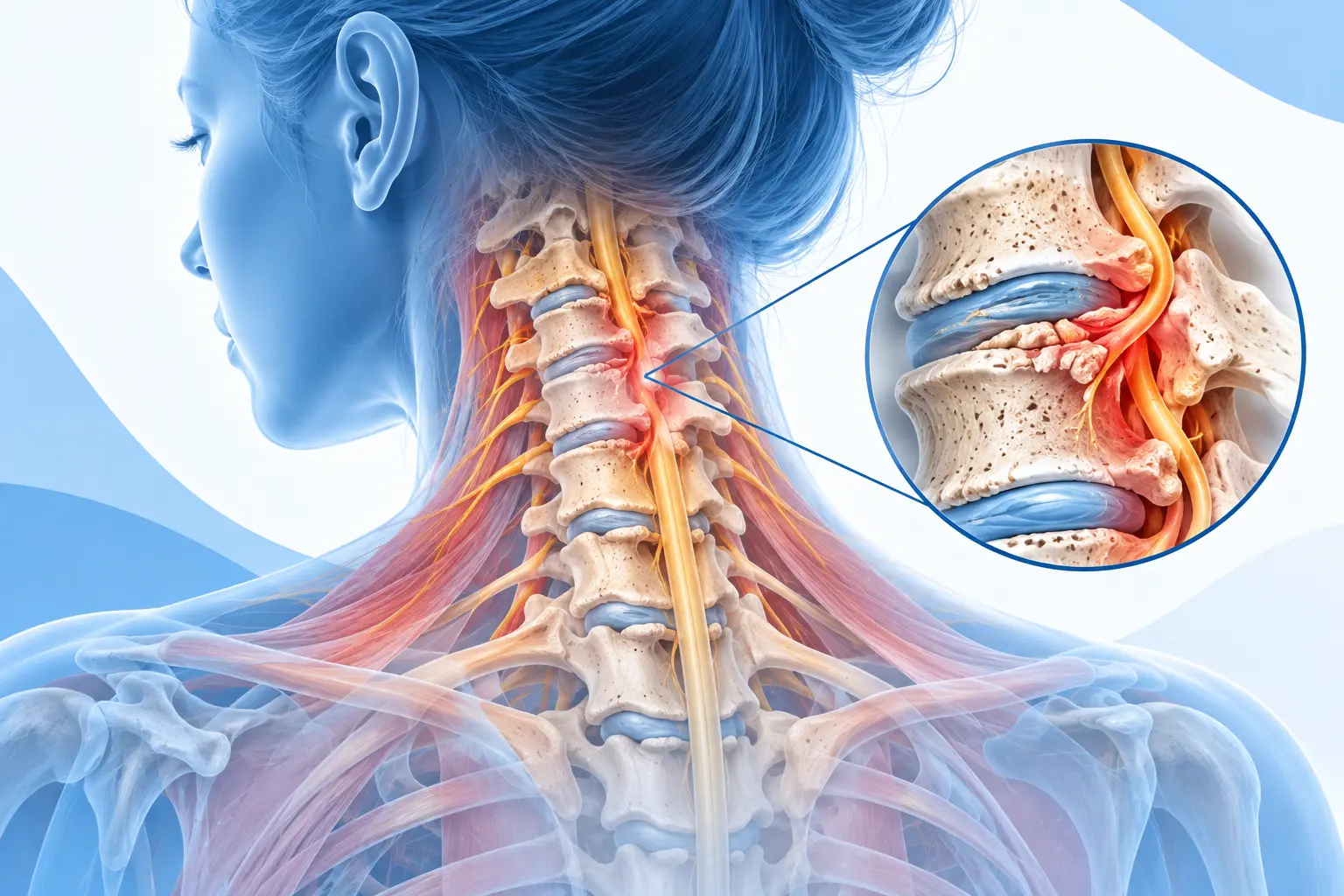
Cervical spondylosis symptoms often begin quietly as a stiff neck, then slowly spread into the shoulders, arms and head.
If you live in Coimbatore and spend long hours at a desk, on a two-wheeler or on your phone, this guide will help you understand what your neck is trying to tell you. You will learn the warning signs, the underlying causes and the risk factors you can actually change.
Cervical spondylosis is age-related wear and tear of the bones, discs and joints in your neck. Doctors also call it cervical osteoarthritis. It is common after 40, yet more adults in their 30s now report it.
At E-Spine Hospital in Coimbatore, we meet many patients who ignored early signals for months. Spotting the pattern early makes care simpler and recovery smoother.
Common Cervical Spondylosis Symptoms You Should Not Ignore
Cervical spondylosis symptoms vary widely. Some people feel only mild stiffness, while others develop nerve-related pain. Here is how the picture usually unfolds.
Early Neck Symptoms
- Neck stiffness, worst in the morning or after long sitting
- Dull aching pain at the back or sides of the neck
- Pain between the shoulder blades
- Headaches that start at the base of the skull
- A grinding or crackling sound when you turn your head
Nerve-Related Symptoms: Neck Stiffness and Arm Numbness
When a bone spur or bulging disc presses on a nerve root, the problem is called cervical radiculopathy. You may notice:
- Tingling or numbness in the fingers or hand
- Shooting pain that travels from the neck into the arm
- Weak grip, such as difficulty holding a cup or turning a key
- Pain that worsens when you tilt or turn your head
Neck stiffness and arm numbness together are a strong signal to get examined. Nerve irritation rarely settles on its own while the cause continues.
Red-Flag Symptoms That Need Urgent Care
Rarely, the spinal cord itself becomes compressed. Seek medical help quickly if you notice:
- Clumsy hands, or trouble with buttons and handwriting
- Unsteady walking or frequent tripping
- Loss of bladder or bowel control
- Sudden severe weakness in an arm or leg
Cervical Spondylosis Symptoms vs Normal Neck Strain
Not every stiff neck is spondylosis. Simple muscle strain usually settles within a few days and follows a clear trigger, such as an awkward sleeping position.
Pain from spondylosis tends to return again and again. It may last beyond two weeks and can come with numbness, tingling or reduced neck movement. A pattern that keeps repeating deserves a medical opinion.
Cervical Spondylosis Causes: Why Your Neck Wears Down
Understanding cervical spondylosis causes helps you protect your neck early. Your neck has seven vertebrae cushioned by discs. Over the decades, those structures slowly change.
Cervical Disc Degeneration
Discs lose water as we age. They become thinner and less elastic, so they absorb shock poorly. This cervical disc degeneration raises pressure on the joints and, in some people, leads to a bulge or cervical disc prolapse that irritates nearby nerves.
Bone Spurs and Joint Arthritis
As discs flatten, the body forms extra bone, called osteophytes, to stabilise the spine. These spurs can narrow the spaces where nerves exit. That explains many neck pain causes and arm symptoms.
Thickened Ligaments and Muscle Strain
Ligaments along the spine can stiffen and thicken with age. Constant muscle tension from poor posture adds to the strain, so pain often feels worse by evening.
Cervical Spondylosis Risk Factors for Adults in Coimbatore
Age is the biggest factor, but lifestyle matters just as much. These cervical spondylosis risk factors are especially relevant for working adults in Coimbatore:
- Age above 40, when disc wear becomes more pronounced
- Desk and laptop work with the screen below eye level
- Prolonged smartphone use, often called “text neck”
- Daily two-wheeler commutes with a stiff, forward-leaning neck
- Previous neck injury, whiplash or a fall
- Family history of spine or arthritis problems
- Smoking, which affects disc nutrition
- Repetitive overhead work or carrying loads on the head or shoulders
- Low physical activity and poor sleep posture, such as using several pillows
Most of these come down to routine. Everyday habits that quietly worsen cervical spondylosis, like working with the screen too low, add strain year after year.
Cervical spondylosis in Coimbatore affects people from many professions, including IT professionals, teachers, drivers and mill workers. Their routines often keep the neck in one position for hours.
How Doctors Diagnose Cervical Spondylosis Symptoms
A proper diagnosis starts with listening. Your doctor asks when the pain began, what worsens it and whether you feel tingling or weakness. Then the evaluation usually moves through these steps:
- Physical examination: neck movement, muscle strength, reflexes and sensation.
- X-ray: shows narrowed disc spaces and bone spurs.
- MRI scan: shows discs, nerve roots and the spinal cord in detail.
- Nerve conduction studies: used when the cause of arm symptoms is unclear.
At E-Spine Hospital, the spine department handles the clinical assessment, and in-house X-ray and laboratory facilities keep your tests and consultation in one place.
Cervical Spondylosis Treatment: What Your Options Look Like
Most cervical spondylosis symptoms improve with conservative care, which is why non-surgical cervical spondylosis treatment in Coimbatore is usually the first step. Surgery is reserved for severe nerve or spinal cord compression.
Ayurvedic Treatment for Cervical Spondylosis
Ayurveda views neck degeneration through the lens of aggravated Vata. Treatment aims to ease pain, stiffness and inflammation while improving mobility.
Therapies such as abhyangam, kizhi, pichu and nasyam, along with herbal medicines, diet advice and gentle exercise, make up a typical Ayurvedic treatment for cervical spondylosis plan. At E-Spine, each plan is personalised after examination.
Home Care That Supports Recovery
- Keep screens at eye level and take a break every 30 minutes
- Use one supportive pillow instead of a stack
- Practise gentle neck stretches taught by a physiotherapist
- Avoid carrying heavy weights on the head or shoulders
- Apply warmth to relieve muscle stiffness
When to See a Specialist About Cervical Spondylosis Symptoms
Do not wait for severe pain. Book a consultation if your cervical spondylosis symptoms last more than two weeks, keep returning, or disturb your sleep and work.
Visit a spine hospital in Coimbatore immediately if you notice weakness, balance problems or bladder changes. Early evaluation protects nerve function and often keeps treatment simpler.
FAQs on Cervical Spondylosis Symptoms
What are the first cervical spondylosis symptoms?
Morning neck stiffness, a dull ache and headaches from the base of the skull usually appear first. Tingling in the hand may follow as the condition progresses.
Can cervical spondylosis cause dizziness?
Yes, some people feel dizzy or off-balance, especially when turning the head. Dizziness has many causes, so get a medical evaluation instead of assuming.
Is cervical spondylosis curable?
Age-related changes cannot be reversed. However, cervical spondylosis symptoms can be managed well with therapy, posture correction and lifestyle changes, helping many people return to normal routines.
Does cervical spondylosis cause arm pain?
Yes. When a nerve root is pinched, pain, tingling or weakness can travel from the neck down the arm.
Final Thoughts
Recognising cervical spondylosis symptoms early gives you more choices and better comfort. Watch for stiffness, repeated headaches and any tingling in the hands. Then correct the daily habits that strain your neck.
Struggling with Cervical Spondylosis Symptoms? Get Expert Care Today
👉 Book an Appointment | Call: +91 90870 15559
Address:
Edamanasserry Spine Hospital Pvt Ltd,
129/1, Mettupalayam Rd, Surya Nagar,
Narasimhanaickenpalayam,
Coimbatore, Tamil Nadu 641031