


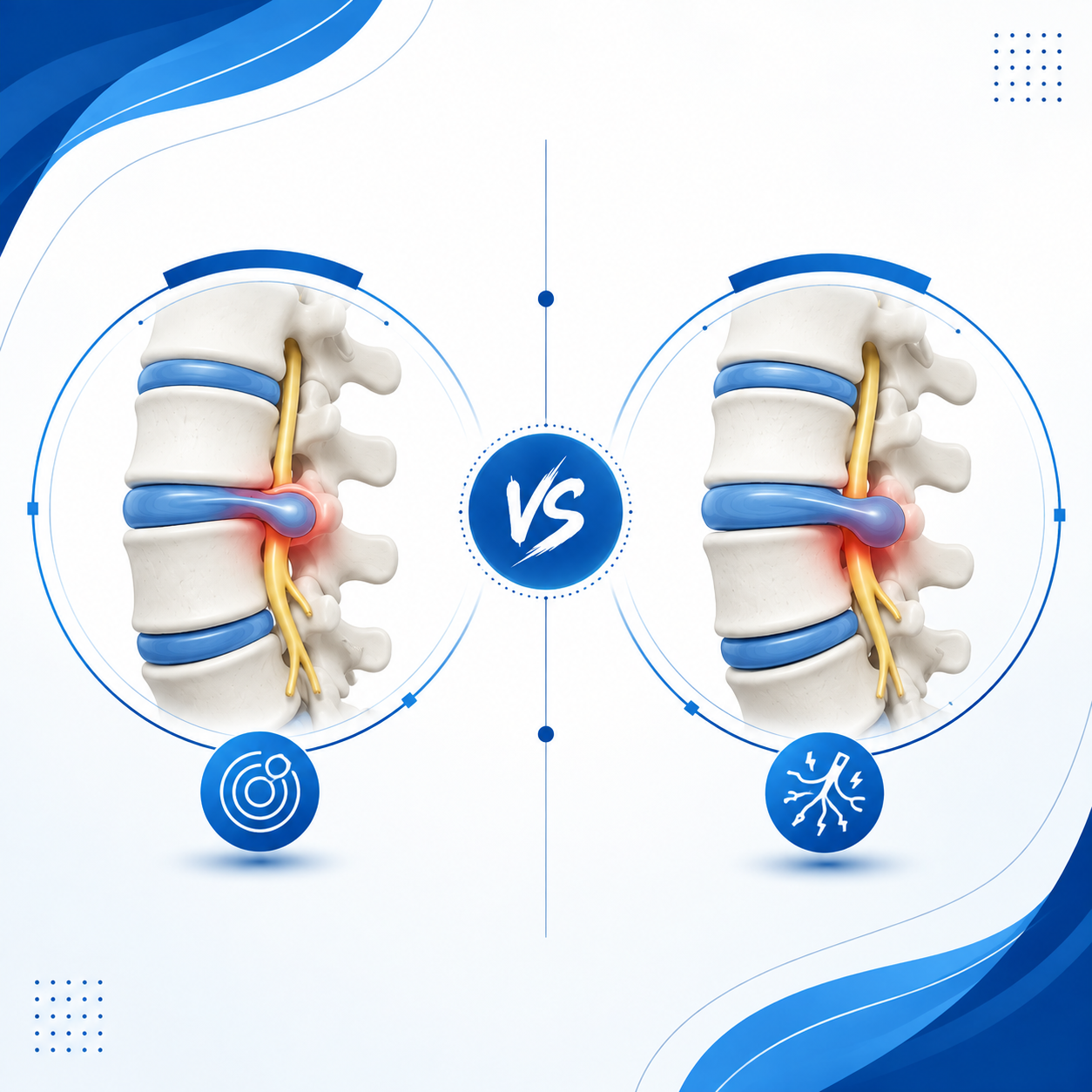
Herniated disc vs slip disc is one of the most common confusions patients bring up during spine consultations, and for good reason — the two terms are often used interchangeably even though they describe the same underlying condition in most medical contexts. If you’re dealing with persistent back or neck pain and trying to understand exactly what’s happening inside your spine, this guide breaks it down clearly before you decide on next steps.
Herniated Disc vs Slip Disc: Are They Actually Different?
In everyday conversation, “slip disc” and “herniated disc” usually refer to the same condition — but the terminology isn’t always used precisely, which is where the confusion in the herniated disc vs slip disc debate comes from.
- Slip disc is a common, informal term used mainly in India and parts of Asia. It suggests the disc has “slipped” out of place.
- Herniated disc is the accurate medical term, describing a disc where the soft inner core (nucleus pulposus) pushes through a crack in the tougher outer layer (annulus fibrosus).
Technically, discs don’t slip — they bulge, tear, or rupture. So while patients use both terms for the same problem, “herniated disc” is the clinically correct description your doctor will use in reports and scans.
Disc Bulge vs Disc Herniation
It’s also worth separating a related but distinct concept: a disc bulge is when the disc protrudes evenly without the outer layer tearing, while a full herniated disc involves an actual rupture. Both can cause similar symptoms, but severity and treatment approach can differ.
Common Causes Behind Herniated Disc vs Slip Disc Cases
Several factors contribute to disc damage over time:
- Age-related wear and tear – Discs lose water content and elasticity with age, making them more prone to injury.
- Poor posture – Prolonged sitting, especially with forward head posture, adds uneven pressure on the lumbar spine.
- Sudden heavy lifting – Lifting with a bent back instead of bent knees is one of the most common triggers.
- Repetitive strain – Jobs involving frequent bending, twisting, or vibration (like long-distance driving) increase risk.
- Genetics and body weight – Family history and excess body weight both add load to spinal discs.
Understanding these lower back pain causes helps patients recognize early warning signs before the condition worsens.
Symptoms: How to Tell If It’s a Herniated Disc or Slip Disc
Whether your doctor calls it a herniated disc or you’ve been told it’s a slip disc, the symptoms usually overlap:
- Sharp or burning pain in the lower back or neck
- Pain that radiates down one leg or arm
- Numbness or tingling in the affected limb
- Muscle weakness in the legs or feet
- Pain that worsens with sitting, coughing, or bending
When the herniation presses on the sciatic nerve, patients often describe it as sciatica pain relief–seeking discomfort — a shooting pain that runs from the lower back through the buttock and down the leg. This is one of the clearest signs that a disc issue, rather than simple muscle strain, is involved.
Neck vs Lower Back Involvement
A herniated disc vs slip disc case in the neck (cervical spine) tends to cause arm pain, shoulder stiffness, and headaches, while lumbar cases affect the lower back and legs. The treatment approach differs slightly depending on location, which is why an accurate diagnosis matters before starting any neck and back pain treatment plan.
How Herniated Disc vs Slip Disc Is Diagnosed
A proper diagnosis typically involves:
- Physical examination – Checking reflexes, muscle strength, and pain response to specific movements
- MRI scan – The most reliable way to confirm disc herniation and its exact location
- X-ray – Used to rule out other bone-related issues, though it doesn’t show soft disc tissue directly
Getting an accurate diagnosis prevents unnecessary anxiety and helps determine whether non-surgical spine treatment is a realistic option for your case, which it is for the vast majority of patients.
Treatment Options: Surgical vs Non-Surgical Approaches
Many patients assume a herniated disc vs slip disc diagnosis automatically means surgery, but this isn’t true for most cases. Treatment usually starts conservatively:
Conservative and Ayurvedic Treatment Approaches
Traditional Ayurvedic treatment for back pain focuses on reducing inflammation, improving spinal flexibility, and strengthening supporting muscles without surgical intervention. At Edamanasserry Spine Hospital, treatment methodologies developed and refined over generations combine external therapies, internal medicines, and structured physiotherapy to address the root cause rather than just masking symptoms.
Our non-surgical treatment programs are designed specifically for patients looking to avoid invasive procedures wherever medically appropriate. This is supported by our traditional Ayurvedic treatment methods, passed down through the Edamanasserry family’s decades of specialized spine care experience.
When Surgery Becomes Necessary
Surgery is generally considered only when there’s:
- Severe, progressive muscle weakness
- Loss of bladder or bowel control (a medical emergency)
- No improvement after months of consistent conservative treatment
For most patients, especially those catching the condition early, non-surgical care remains the first and most effective line of treatment.
Why Choose an Ayurvedic Spine Hospital in Coimbatore
Patients across Coimbatore and neighboring Kerala regions often prefer an established Ayurvedic spine hospital because it offers a structured, non-surgical pathway backed by decades of specialized experience. Our spine department is staffed by qualified BAMS doctors who focus specifically on spine and musculoskeletal conditions, supported by an in-house physiotherapy team for combined recovery plans.
If you’re searching for a spine specialist Coimbatore patients trust, look for a facility with NABH accreditation, decades of documented experience, and treatment plans tailored to your specific diagnosis rather than a one-size-fits-all protocol.
Preventing Future Disc Problems
Once treated, preventing recurrence matters just as much as initial recovery:
- Maintain correct posture while sitting and standing
- Lift heavy objects using your knees, not your back
- Stay active with low-impact exercises like walking or swimming
- Include regular stretching or yoga into your routine
- Maintain a healthy body weight to reduce spinal load
FAQs About Herniated Disc vs Slip Disc
1. Is slip disc the same as herniated disc? Yes, in most everyday usage, “slip disc” and “herniated disc” refer to the same condition, though “herniated disc” is the medically accurate term.
2. Can a herniated disc heal without surgery? Yes, many cases improve significantly with non-surgical treatment, including Ayurvedic therapies, physiotherapy, and lifestyle changes, especially when caught early.
3. How long does slip disc pain usually last? With consistent treatment, many patients see noticeable improvement within a few weeks, though full recovery timelines vary based on severity.
4. Is walking good for a herniated disc? Yes, gentle walking is generally recommended as it improves circulation and supports spinal health, but high-impact activity should be avoided during acute pain.
5. When should I see a doctor for back pain? See a doctor promptly if pain radiates down a limb, is accompanied by numbness or weakness, or persists beyond a couple of weeks despite rest.
Get Expert Ayurvedic Spine Care in Coimbatore
Understanding the difference in the herniated disc vs slip disc conversation is the first step — the next is getting an accurate diagnosis and a treatment plan that avoids surgery wherever possible. Edamanasserry Spine Hospital has been treating spine conditions with traditional, family-developed Ayurvedic methodologies for over 50 years.
📍 Address: Edamanasserry Spine Hospital Pvt Ltd, 129/1, Narasimhanaikan Palayam, Mettupalayam Main Road, Coimbatore – 641031
👉 BOOK YOUR SPINE CONSULTATION NOW