


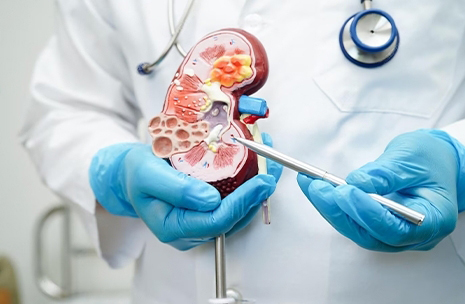
Renal Calculi
Kidney stones (also called renal calculi, nephrolithiasis or urolithiasis), medically known as Renal Calculi, are hard deposits of minerals and salts that form in the kidneys. They can vary in size, from as small as a grain of sand to as large as a golf bal
Causes :
- Kidney stones form when your urine contains more crystal-forming substances — such as calcium, oxalate, and uric acid — than the fluid in your urine can dilute. At the same time, your urine may lack substances that prevent crystals from sticking together, creating an ideal environment for kidney stones to form.
- Low Water Intake
- Sedentary Lifestyle
- Too Much Protein and Sodium in the Diet
- Obesity
- Medication
- Aerated Drinks
Signs :
A kidney stone usually will not cause symptoms until it moves around within the kidney or passes into one of the ureters. The ureters are the tubes that connect the kidneys and bladder.
If a kidney stone becomes lodged in the ureters, it may block the flow of urine and cause the kidney to swell and the ureter to spasm, which can be very painful
- Extreme Pain: Kidney stones can cause severe pain in the lower abdomen, which often moves around in the stomach and back region.
- Change in Urine Colour and Consistency: With kidney stones, the urine becomes cloudy with a foul odour, and the colour may turn light red or brown due to blood in the urine.
- Burning Sensation: Kidney stones cause pain and a burning sensation while urinating. However, you may also experience similar symptoms from a urinary tract infection.
Other symptoms of kidney stones include:
- Nausea and/or vomiting with pain
- Blood in the urine
- Inability to urinate
- Frequent urination
- Foul smell in urine and cloudy appearance
Pain caused by a kidney stone may change — for instance, shifting to a different location or increasing in intensity — as the stone moves through your urinary tract.
Types :
- Calcium stones – Most kidney stones are calcium stones, usually in the form of calcium oxalate. Eating too much oxalate-rich foods like spinach, chocolate, and nuts can increase the risk of calcium stones.
- Struvite stones – Struvite stones form in response to a urinary tract infection. These stones can grow quickly and become quite large, sometimes with few symptoms or little warning.
- Uric acid stones – Uric acid stones can form in people who lose too much fluid because of chronic diarrhea or malabsorption, those who eat a high-protein diet, and those with diabetes or metabolic syndrome. Food high in purines, like red meat and shellfish, can lead to uric acid stone formation.
- Cystine stones – These stones form in people with a hereditary disorder called cystinuria that causes the kidneys to excrete too much of a specific amino acid.
Calcium Oxalate is the most common kidney stone found in 80% of the cases. The rare types include cystine stones, struvite stones and uric acid stones.
Ayurvedic Approach :
According to Ayurveda, the body’s Kapha composition may dry out when there’s an imbalance in the Vata Dosha levels. This can lead to kidney stones.
In Ayurveda, kidney stones are referred to as ‘Ashmari.’
In Ayurveda, kidney stones are seen as a result of imbalances in the body’s doshas (Vata, Pitta, and Kapha) and the buildup of toxins (ama).
Treatment :
Maintain the dosha in a balanced state and cleanse the toxins by detox treatment. This includes changing Diet, using herbs, drinking lots of water, doing detox treatments called Panchakarma, and making lifestyle changes. Ayurveda treatments will avoid the recurrence of Kidney Stones.
- Drink More Water – Drinking more and more water ensures that your body is hydrated and helps flush out wastes and toxins. When such toxins and wastes are not eliminated regularly, they may combine to form kidney stones. Water can also act as a medium for the stones to pass out from the body.
- Panchakarma Therapy – Panchakarma, a detoxification and rejuvenation therapy in Ayurveda, is highly beneficial for kidney stone patients. Procedures like Virechana (therapeutic purgation) and Basti (medicated enema) help in detoxifying the body, balancing the doshas, and improving kidney function.
- Stick to an Ayurvedic Diet – According to Ayurveda, smaller kidney stones can be eliminated by sticking to a suitable sattvic diet, consuming more water, and taking preventive measures.
Consuming liquids in adequate quantities daily may help flush out kidney stones and also provide kidney stone pain relief.